Brand Guide: Sunbank, Duda, Heliatos & More (Who Makes What)
 Nov 29, 2025

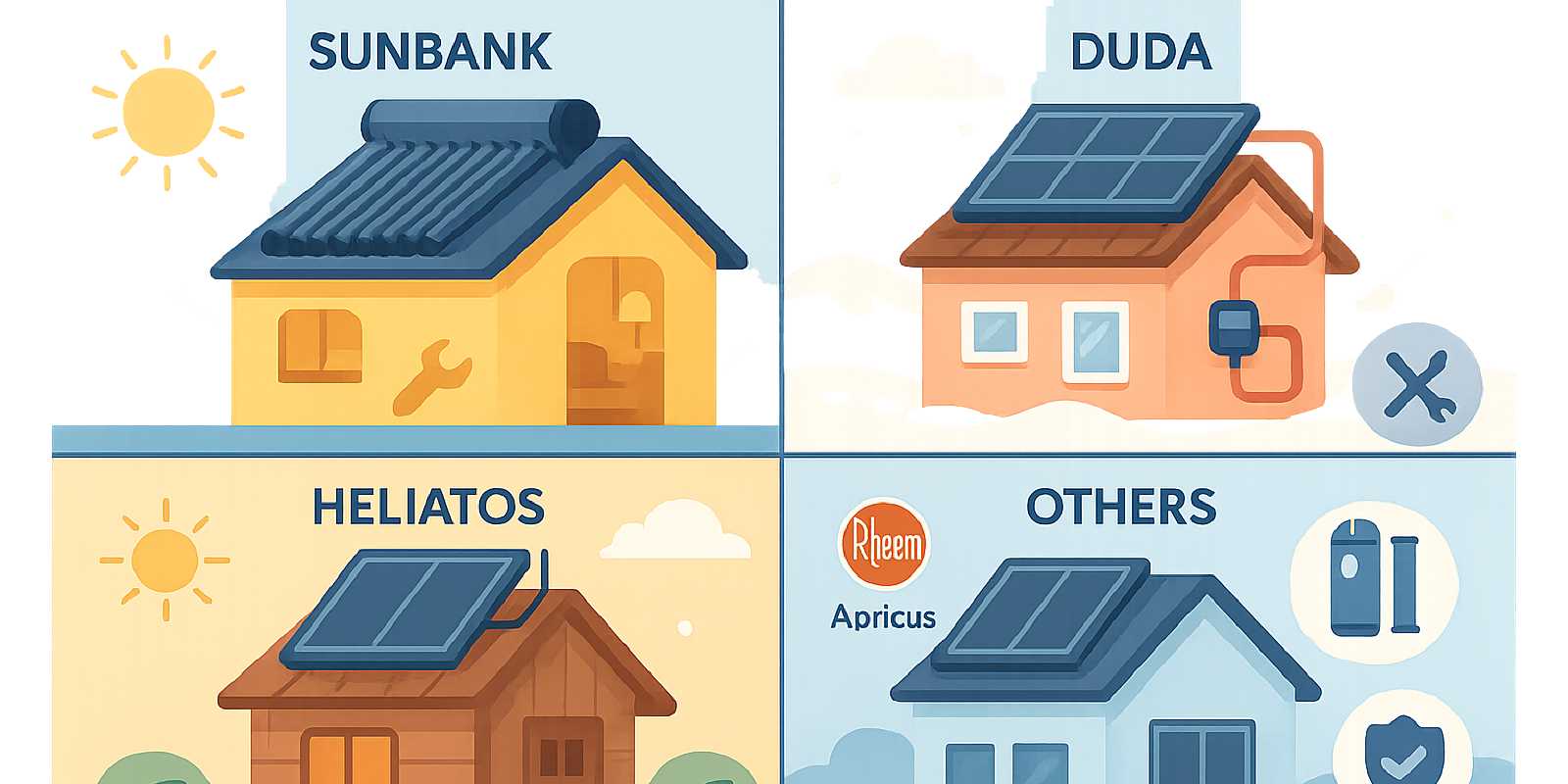
Shopping for a solar water heater with tank can feel overwhelming when you’re faced with dozens of brands, each claiming the best efficiency or easiest installation. This brand guide cuts through the marketing noise to help you compare leading solar water heater brands, understand what each manufacturer does best, and match the right system to your climate, budget, and hot water needs.
Whether you’re considering solar water heating kits for a DIY retrofit or a professionally installed solar domestic water heating system, this article delivers the data-backed insights you need to choose confidently.

🌐 Industry Overview: How Solar Water Heater Brands Differ
The solar water heater market divides into three main categories: passive thermosiphon systems, active pressurized collectors, and modular DIY kits. Each category serves different audiences and installation scenarios.
Passive systems use gravity circulation with the storage tank mounted above the collector array. These systems have no pumps, minimal maintenance, and low upfront cost, but they’re best suited for freeze-free climates and simple roof layouts.
Active systems employ pumps, controllers, and heat exchangers to circulate glycol or water through solar collector panels. They offer flexible tank placement, freeze protection, and higher efficiency in cold or cloudy weather, but at higher cost and complexity.
Modular DIY kits provide pre-engineered components that homeowners can install themselves, often using small solar hot water collectors paired with existing tanks. These kits balance cost and performance for handy renovators.
Key differentiators across brands include:
- Collector type: Evacuated tubes vs flat-plates (evacuated tubes vs flat-plates)
- Certification: SRCC OG-100 (collectors) and OG-300 (complete systems) unlock federal tax credits
- Warranty length: Collector warranties range from 5 to 10 years; tank warranties from 1 to 10 years
- Climate fit: Some brands specialize in freeze protection; others optimize for sunbelt performance
- Support quality: Installation manuals, video tutorials, and responsive tech support vary widely
Understanding these differences helps you evaluate whether a solar water heater brand meets your specific needs before you invest thousands of dollars.

☀️ Sunbank: The DIY-Friendly Solar Water Heater Brand
Sunbank has built a reputation for passive thermosiphon systems that prioritize simplicity, durability, and owner installation. Their flagship models—the SB-40G (40 gallon) and SB-80G (80 gallon)—feature evacuated tube collectors integrated with stainless steel storage tanks.
System Design & Performance
Sunbank systems use 316L stainless steel tanks (argon arc welded for corrosion resistance) with 55mm high-density polyurethane insulation. The collectors employ 15 evacuated tubes (SB-40G) or 30 tubes (SB-80G) made from high-strength borosilicate glass with nickel-plated copper heat pipes.
The evacuated tube design achieves 92% thermal efficiency, according to Sunbank’s SRCC OG-100 certification, by minimizing convective and radiative heat loss through vacuum insulation. This high efficiency translates to strong performance even in partial sun or cooler weather.
Customer reviews consistently report only 5°F overnight temperature loss in the insulated tanks, a testament to the quality insulation and passive heat retention.
Pricing & Economics
As of December 2025, Sunbank pricing (before shipping) is:
- SB-40G: $2,999 retail ($2,099 after 30% federal tax credit)
- SB-80G: $4,999 retail ($3,499 after 30% federal tax credit)
Shipping adds $200–$600 depending on location. Both systems qualify for the federal solar tax credit through 2025 thanks to SRCC OG-300 system certification.
Installation Experience
Sunbank markets heavily to DIY installers. Customer testimonials indicate installation typically takes 12–24 hours over a weekend for homeowners with basic plumbing and roofing skills. Professional installation runs $500–$1,500 and takes 8–16 hours.
The passive design eliminates pumps, controllers, and electrical work, simplifying installation. However, the tank must be mounted above the collectors to enable thermosiphon circulation, which limits roof flexibility on some homes.
Sunbank provides detailed installation manuals and video tutorials to support DIYers, and their customer service receives strong reviews for responsiveness.
Warranty & Support
- Collectors: 10-year warranty
- Tank and components: 1-year warranty
- Design life: 30 years (SB-80G)
The 10-year collector warranty is competitive, though some brands offer longer tank coverage. The passive, no-moving-parts design minimizes maintenance and extends real-world longevity.
Best For
Sunbank excels for sunny, freeze-free climates (southern California, Arizona, Florida, Hawaii) where passive systems perform reliably year-round. The brand suits homeowners who value simplicity, plan to DIY, and want a proven thermosiphon design with strong efficiency.
Sunbank is less ideal for cold climates without freeze protection add-ons, or for installations where tank placement above collectors is impractical.
For more on passive system advantages and limitations, see our passive vs active guide.

🏭 Duda: Customizable Pressurized Collectors & Kits
Duda Solar (Duda Energy) offers a wider range of solar water heating kits than most competitors, with both evacuated tube and flat-plate options, active and passive configurations, and tank sizes from 40 to 200+ liters.
System Flexibility
Duda’s strength lies in customization. Their kits let you choose:
- Collector type: Flat-plate or evacuated tubes
- Tank configuration: Dual-coil indirect tanks with heat exchangers for glycol loops, or direct thermosiphon tanks
- Pump stations: Pre-packaged controller, pump, and expansion tank assemblies for active systems
- Mounting hardware: Roof, ground, or wall mounts
This modularity appeals to installers and advanced DIYers who need to adapt the system to specific site conditions, climates, or existing plumbing.
Pricing & Value
Duda’s 40-gallon kits retail for $2,700–$3,200 before shipping ($1,890–$2,240 after tax credit). The 80-gallon kits run $4,200–$4,800 ($2,940–$3,360 after credit). Shipping adds $250–$650.
Duda typically prices slightly below Sunbank for comparable capacity, though exact comparisons depend on chosen components.
Installation & Support
DIY installation of a Duda active system typically takes 16–24 hours due to the added complexity of pumps, controllers, and glycol filling. Professional installs run 10–20 hours and cost $600–$1,800.
A Florida homeowner on solar forums reported a professional Duda 80-gallon install at 14 labor hours and $1,200 total for labor and materials—competitive with other brands.
Duda provides solid technical documentation and responsive support, though some users report longer wait times during peak seasons compared to smaller brands.
Warranty & Certification
- Collectors: 10-year warranty
- Tanks: 1-year warranty
- Certification: SRCC OG-300 and OG-100 on most kits
Duda’s warranty terms match industry norms. The SRCC certifications ensure eligibility for federal incentives and verified performance ratings.
Best For
Duda suits cold-climate installations where freeze protection via glycol loops is essential. Their active systems with flat-plate or evacuated tube collectors perform well in regions with extended cloudy periods or sub-freezing winters.
Duda also appeals to professionals and experienced DIYers who want component flexibility and the ability to scale systems for larger households or commercial use.
For a step-by-step walkthrough of installing an active system similar to Duda’s offerings, see our installation guide.

🏡 Heliatos: Modular Systems for Off-Grid & Tiny Homes
Heliatos positions itself as the retrofit specialist, offering compact solar pv water heater add-on kits designed to preheat existing electric or gas tanks rather than replace them.
System Approach
Heliatos kits use small flat-plate collectors paired with a low-voltage DC pump powered by a dedicated photovoltaic panel. Cold water feeds through the collectors, gets preheated, and returns to the existing tank’s inlet—boosting solar contribution without major plumbing changes.
This hybrid approach appeals to homeowners who want solar savings without the cost or complexity of a full standalone system. The kits work best in sunny climates where consistent preheating reduces backup heater runtime.
Pricing & Economics
Heliatos 40-gallon kits retail for $2,500–$3,000 ($1,750–$2,100 after tax credit). The 80-gallon kits run $4,000–$4,500 ($2,800–$3,150 after credit). Shipping adds $200–$600.
These prices position Heliatos as the most affordable option among the three brands reviewed here, especially for retrofits where you’re keeping your existing tank.
Installation Experience
An Arizona homeowner reported installing a Heliatos 50-gallon kit in 16 hours over a weekend, praising the clear instructions and ease of integration with their existing electric heater.
DIY installs typically take 12–20 hours. Professional installs run 8–16 hours at $500–$1,500. The modular design and PV-powered pump eliminate the need for AC electrical work, simplifying permitting and installation.
Warranty & Certification
- Collectors: 10-year warranty
- Tanks: 1-year warranty (when purchased)
- Certification: SRCC OG-300 and OG-100
Heliatos systems qualify for the federal tax credit and carry competitive warranties, though real-world performance data is less abundant than for longer-established brands.
Best For
Heliatos excels for off-grid cabins, tiny homes, and RV/van setups where compact, PV-powered systems integrate easily. The brand also suits budget-conscious retrofits in sunny regions (Southwest, California, Hawaii) where you want to add solar capacity without replacing a functioning tank.
Heliatos is less suited for cold climates without freeze protection add-ons, or for users who want a high-capacity standalone system. The small collectors limit total BTU output compared to larger evacuated tube arrays.
For more on DIY retrofit kits, explore our detailed buyer’s guide.

📊 Other Leading Brands: Rheem, SunEarth, Apricus & More
While Sunbank, Duda, and Heliatos represent popular solar water heater brands in the residential DIY and retrofit markets, several other manufacturers deserve consideration:
Rheem Solaraide
Rheem offers solar-ready indirect storage tanks (80–300 liters) with built-in heat exchangers and electric backup elements. Pair these tanks with flat-plate collectors from SunEarth or Heliodyne for a hybrid solar/electric system.
Strengths: Strong brand recognition, excellent warranty support (up to 6 years on tanks), and easy integration with conventional plumbing. Ideal for professional installs where the installer sources collectors separately.
Pricing: Tanks run $800–$1,400; add $1,500–$3,000 for collector arrays.
SunEarth & Heliodyne
These California-based brands specialize in glazed flat-plate collectors with SRCC OG-100 certification. Typical kits pair two 4×8 ft collectors with an 80-gallon tank, pump station, and controller.
Strengths: Proven performance in sunny climates, pre-engineered packages, and strong installer networks. SunEarth and Heliodyne systems have been field-tested for 30+ years.
Best for: Warm, sunny regions (Southwest, California) where flat-plates deliver excellent summer performance. Less ideal for extreme cold or extended cloudy periods.
Pricing: Complete systems run $4,000–$6,000 before tax credits.
Apricus
Apricus focuses on evacuated tube systems (30-tube arrays with 80-gallon tanks) designed for cold and cloudy climates. Their tubes excel in winter performance and maintain efficiency in windy or overcast conditions.
Strengths: Superior cold-weather performance, durable tubes, SRCC certification, and strong winter BTU output. Tubes are modular and individually replaceable.
Best for: Northern states, high-altitude installations, and regions with significant winter heating demand.
Pricing: Systems typically cost $5,000–$7,000 before incentives.
SunMaxx
SunMaxx offers both flat-plate (TitanPower Plus) and evacuated tube (EvacuMax) kits with tanks, controllers, and robust warranties. Their systems target both residential and light commercial use.
Strengths: High efficiency, U.S.-based tech support, and flexible sizing. SunMaxx systems often include advanced controllers with data logging and remote monitoring.
Pricing: $4,500–$8,000 depending on size and collector type.
Comparison Table: Leading Solar Water Heater Brands
| Brand | Capacity | Collector Type | Retail Price | After Tax Credit | Warranty (Col/Tank) | Best Climate |
|---|---|---|---|---|---|---|
| Sunbank | 40 gal | Evac. tubes | $2,999 | $2,099 | 10y / 1y | Sunny, freeze-free |
| Sunbank | 80 gal | Evac. tubes | $4,999 | $3,499 | 10y / 1y | Sunny, freeze-free |
| Duda | 40 gal | Evac./flat | $2,700–$3,200 | $1,890–$2,240 | 10y / 1y | Cold, variable sun |
| Duda | 80 gal | Evac./flat | $4,200–$4,800 | $2,940–$3,360 | 10y / 1y | Cold, variable sun |
| Heliatos | 40 gal | Flat-plate | $2,500–$3,000 | $1,750–$2,100 | 10y / 1y | Sunny retrofit |
| Heliatos | 80 gal | Flat-plate | $4,000–$4,500 | $2,800–$3,150 | 10y / 1y | Sunny retrofit |
| Rheem | 80 gal | Indirect tank | $2,300–$4,000 | $1,610–$2,800 | Varies | Hybrid solar/elec |
| SunEarth | 80 gal | Flat-plate | $4,000–$6,000 | $2,800–$4,200 | 10y / 5y | Sunny, professional |
| Apricus | 80 gal | Evac. tubes | $5,000–$7,000 | $3,500–$4,900 | 10y / 5y | Cold, cloudy |
Note: Prices exclude shipping ($200–$650). All systems with SRCC OG-300 certification qualify for 30% federal tax credit through 2025. For detailed cost breakdowns, see our solar water heater cost guide.

🎯 Choosing the Right Brand for Your Climate, Budget & Use-Case
Selecting a solar water heater brand requires matching system characteristics to your specific conditions. Use this decision matrix to narrow your options:
Climate-Zone Selector
Hot & sunny (California, Arizona, Florida, Hawaii):
- Top choice: Sunbank (passive thermosiphon, 92% efficiency, low maintenance)
- Alternatives: Heliatos (retrofit kits), SunEarth (flat-plates)
- Rationale: Passive systems excel in freeze-free zones. Flat-plates deliver strong summer performance at lower cost than evacuated tubes.
Cold winters & moderate sun (Northeast, Midwest, Mountain West):
- Top choice: Duda (glycol loops, freeze protection)
- Alternatives: Apricus (evacuated tubes for winter output)
- Rationale: Active indirect systems with glycol protect against freezing. Evacuated tubes maintain efficiency in cold and clouds.
Mixed climate with freeze risk (Pacific Northwest, Mid-Atlantic):
- Top choice: Duda or SunMaxx (flexible configurations)
- Alternatives: Drainback systems from component suppliers
- Rationale: Choose systems with proven freeze protection. Consider drainback for simplicity or glycol for reliability.
Off-grid or tiny home:
- Top choice: Heliatos (PV-powered, compact)
- Alternatives: Portable thermosiphon kits, DIY batch heaters
- Rationale: Minimize complexity and electrical draw. Modular systems adapt to non-standard installations.
Budget Considerations
Lowest upfront ($1,750–$2,500 after incentives):
- Heliatos retrofit kits, DIY batch heaters
- Best for budget-conscious solar savings without full system replacement
Mid-range ($2,000–$3,500 after incentives):
- Sunbank passive systems, Duda 40-gallon kits
- Best balance of performance, cost, and DIY-friendliness
Premium ($3,500–$5,000+ after incentives):
- Apricus evacuated tubes, SunMaxx advanced systems, large Duda configurations
- Best for maximizing solar fraction in challenging climates or high-demand households
Installation Skill Level
Beginner DIY (basic plumbing skills):
- Heliatos retrofit kits, simple Sunbank thermosiphon
- Look for systems with minimal components and strong video support
Intermediate DIY (comfortable with roof work, plumbing, basic electrical):
- Sunbank passive systems, Duda passive kits
- Expect 12–24 hours of labor; manageable over a weekend
Advanced DIY (experienced with HVAC, complex plumbing, controllers):
- Duda active systems, SunMaxx kits
- Budget 16–24 hours; requires glycol filling, electrical work, sensor placement
Professional install only:
- Large evacuated tube systems, commercial applications, complex roof layouts
- Budget $600–$1,800 for labor; 8–20 hours
For installation guidance, see our step-by-step installation article and DIY kit reviews.
Household Size & Demand
- 1–2 people: 40-gallon systems from any brand
- 3–4 people: 80-gallon systems; consider Sunbank or Duda
- 5+ people: Multiple 80-gallon tanks or commercial-grade systems (SunMaxx, large Duda kits)
Size systems to cover 60–80% of annual hot water demand, with backup for cloudy periods and peak loads. For sizing help, see our solar water heaters 101 guide.

🛡️ Warranty & Support Showdown: What Each Brand Promises
Warranty coverage and customer support quality vary significantly across solar water heater brands. Here’s what you need to know:
Warranty Comparison
| Brand | Collector Warranty | Tank Warranty | Components | Support Quality |
|---|---|---|---|---|
| Sunbank | 10 years | 1 year | 1 year | Excellent (responsive, helpful) |
| Duda | 10 years | 1 year | 1 year | Good (tech docs strong, slower peak seasons) |
| Heliatos | 10 years | 1 year | 1 year | Good (growing track record) |
| Rheem | Varies | Up to 6 years | Varies | Excellent (established brand support) |
| SunEarth | 10 years | 5 years | 5 years | Excellent (installer network) |
| Apricus | 10 years | 5 years | Varies | Very good (modular tube replacement) |
What Warranties Cover
Collector warranties typically cover vacuum tube integrity, absorber coating degradation, and manifold leaks. Damage from improper installation, overheating (dry stagnation), or physical impact is usually excluded.
Tank warranties cover manufacturing defects, weld failures, and coating failures. Anode rod replacement is often required to maintain warranty validity. Sediment buildup and lack of maintenance void most tank warranties.
Component warranties include pumps, controllers, sensors, and valves. These parts have shorter lifespans (typically 5–10 years) and are more prone to failure than collectors.
Support Quality Insights
Based on customer reviews and forum discussions:
- Sunbank earns praise for responsive email and phone support, clear installation videos, and willingness to troubleshoot DIY issues. A Virginia restaurant owner reported six years of reliable operation with no service calls needed.
- Duda provides solid technical documentation and parts availability, though some users report slower response times during peak solar water heater sales seasons (spring and summer).
- Heliatos is building a strong reputation for DIY support, with detailed manuals and video content. Limited long-term field data reflects the brand’s newer market presence.
- Rheem benefits from decades of water heater experience and extensive dealer/installer networks. Parts availability is excellent, and warranty claims are processed efficiently.
- SunEarth/Heliodyne provide professional-grade support and strong installer relationships, but less DIY hand-holding compared to Sunbank or Heliatos.
Maintenance Requirements
All solar domestic water heating systems require periodic maintenance to preserve warranty coverage and performance:
- Annual inspection: Clean collectors, check insulation, test controls
- Glycol replacement: Every 3–5 years for closed-loop systems
- Anode rod inspection: Annually for steel tanks
- Sediment flushing: Annually or as needed
For a complete maintenance schedule, see our maintenance and winterization guide.
Common Failure Modes (Based on Limited Public Data)
The research uncovered limited public failure data for these brands. However, general patterns across solar water heating systems include:
- Pump failures: 10–15 year lifespan for active systems
- Controller malfunctions: Sensor drift, relay failures (often easily replaced)
- Tube breakage: Rare with quality evacuated tubes; usually impact damage
- Tank corrosion: Prevented by anode rod maintenance and proper water chemistry
- Freeze damage: Almost always due to inadequate protection in cold climates
Sunbank’s passive design (no pumps or controllers) eliminates the most common active-system failure points, explaining their strong reliability reports.

❓ FAQ: Solar Water Heater Brand Questions Answered
Which solar water heater brand is most reliable?
Sunbank earns strong reliability marks for passive thermosiphon systems due to no moving parts and quality stainless steel tanks. Rheem leads for conventional solar-ready tanks with decades of field history. Choose based on your climate and system type.
Do I need SRCC certification to get the federal tax credit?
Yes. The federal Residential Clean Energy Credit requires SRCC OG-300 certification for complete systems. All brands reviewed here (Sunbank, Duda, Heliatos, Rheem, SunEarth, Apricus) offer certified models. Verify certification before purchase.
Can I install a Sunbank or Duda system myself?
Yes, if you have basic plumbing and roofing skills. Sunbank passive systems are the easiest DIY option (12–24 hours). Duda active systems require more expertise (16–24 hours) due to pumps, controllers, and glycol. Professional installation costs $600–$1,800.
How do evacuated tubes compare to flat-plates for different brands?
Evacuated tubes (Sunbank, Duda tubes, Apricus) achieve 92% efficiency and excel in cold or cloudy weather. Flat-plates (Duda flat, Heliatos, SunEarth) cost less and work well in sunny climates but lose more heat in wind and cold. See our evacuated tubes vs flat-plates comparison.
What’s the best brand for cold climates?
Duda and Apricus lead for cold climates thanks to glycol-based freeze protection and evacuated tube efficiency. SunMaxx also performs well. Avoid passive systems without freeze protection in regions with hard freezes.
Are solar pv water heaters different from solar thermal systems?
Yes. A solar pv water heater uses photovoltaic panels to power an electric heating element or pump, while solar thermal systems (like Sunbank, Duda, SunEarth) use solar hot water collectors to directly heat water. Heliatos offers a hybrid using PV to power a thermal collector pump. See our solar thermal vs PV showdown.
How much do shipping costs add to solar water heater sales prices?
Expect $200–$650 for shipping depending on brand, system size, and location. Sunbank charges $200–$600; Duda $250–$650; Heliatos $200–$600. Order directly from manufacturers when possible to reduce costs, or buy through Amazon with Prime shipping if available.
Do these brands work for pool heating?
Some brands (SunEarth, Heliodyne) offer dedicated pool heating panels. Sunbank and Duda focus on domestic hot water. For pool heating, see our solar pool heating 101 guide and best solar pool heaters.
Can I retrofit a Heliatos kit to my existing electric tank?
Yes. Heliatos specializes in retrofit kits that preheat water before it enters your existing tank. This reduces backup heater runtime and cuts energy bills without replacing your functional tank. Install details in our DIY retrofit kits article.
What’s the typical payback period by brand?
Payback depends on climate, energy rates, and incentives more than brand. Expect 5–15 years for most systems. Sunbank and Heliatos often hit the lower end (5–10 years) in sunny, high-rate regions. Apricus may take longer upfront but saves more in cold climates. See our cost and savings calculator.
Related Articles
- Solar Water Heaters 101: Types, Pros, Cons, Sizing & How They Work
- Passive vs Active Solar Water Heating: Which One Fits Your Home?
- Evacuated Tubes vs Flat-Plate Collectors: Performance in All Climates
- Solar Water Heater Costs in 2025: Price Ranges & Payback Examples
- Rebates & Credits: How to Qualify for Solar Hot Water Incentives
- Step-by-Step: Installing a Residential Solar Water Heating System
- Best DIY Retrofit Kits for Existing Electric & Gas Heaters
- Maintenance & Winterization: Keep Your Solar Hot Water Running