Dec 21, 2025

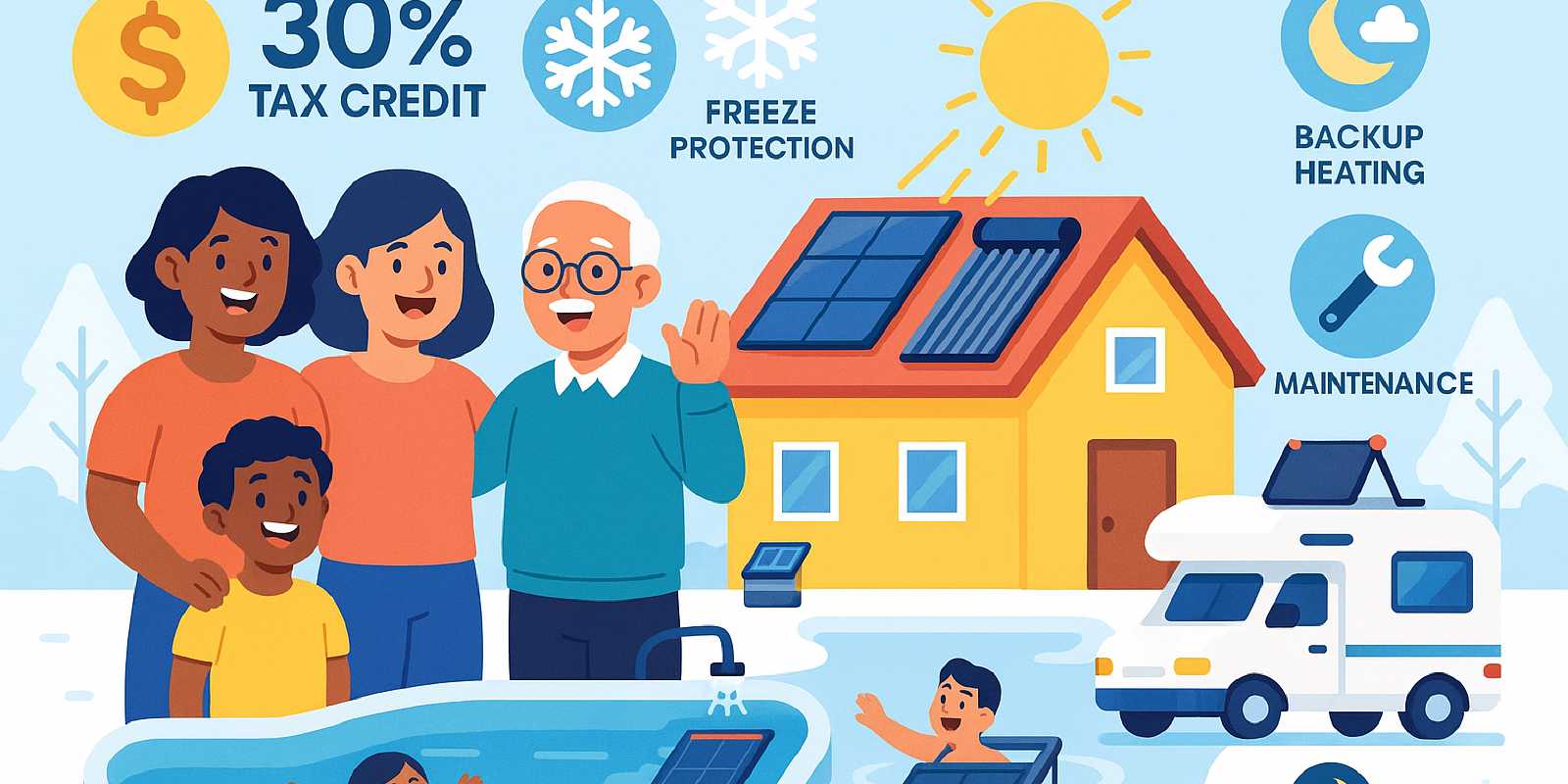
If you’re considering solar water heating, you probably have a dozen urgent questions bouncing around your head: Will it really save money? Does it work in winter? What about cloudy days and nighttime? Can it heat a pool or power an RV shower? This FAQ delivers the straight answers you need—backed by real data, field tests, and homeowner experiences—so you can decide with confidence and zero fluff.
Whether you’re a sustainability enthusiast weighing long-term savings, a DIY renovator mapping out your next project, or an off-grid prepper seeking reliable hot water without utility bills, you’ll find the rapid, practical answers you came for. Let’s dive in.

💰 Is a Solar Water Heater Worth the Upfront Cost?
Short answer: Yes, for most sunny or moderate climates—especially when incentives apply.
Residential solar water heaters typically cost between $4,000 and $8,000 installed before incentives, according to the U.S. Department of Energy . Compare that to a conventional electric resistance heater at $500–$1,500 or a gas unit at $600–$2,000, and the gap looks daunting. But here’s where the math shifts in your favor:
- Federal tax credits: The Residential Clean Energy Credit returns 30% of your total installed cost through 2032. A $6,000 system nets you $1,800 back, dropping your real cost to $4,200.
- State and utility rebates: Many regions stack additional cash incentives, grants, or low-interest loans on top of the federal credit, further shrinking upfront costs.
- Long-term savings: Solar cuts water-heating energy by 50–80%, depending on your climate and system sizing. At $40–$60/month in electric water heating costs, you save $500–$1,000 annually—leading to typical payback periods of 5–10 years in sunny states.
Field data from cold climates reinforces this. In Massachusetts and Wisconsin, systems achieved a 61–63% annual solar fraction (percentage of total hot water provided by solar), with monthly fractions ranging from 19% in dark December to 87% in sunny August (DOE Cold Climate Report ). Even in winter-dominant regions, solar substantially reduces your backup heater’s workload.
Will Solar Water Heating Costs Rise or Fall?
Collector and tank prices have stabilized, but installation labor can vary. Incentive landscapes shift every few years, so lock in the 30% federal credit while it’s guaranteed through 2032. Rising electric and gas rates make solar’s fixed upfront cost look better every year—you’re essentially pre-paying for decades of hot water at today’s prices.
💡 Personal Tip: Before committing, use an interactive payback calculator (like the one on our cost and payback guide ) to model your specific household size, local energy rates, and sun exposure. I ran the numbers for my California home and discovered payback in under 10 years—even accounting for a shaded corner that reduced output by about 15%.
Comparing Solar to Conventional Systems
| System Type | Installed Cost (USD) | Operating Cost/Year | Payback Period | Lifespan |
|---|---|---|---|---|
| Solar (active indirect) | $4,000–$8,000 | Near zero* | 5–10 years | 20–30 yr |
| Electric resistance | $500–$1,500 | $480–$720 | N/A | 10–15 yr |
| Gas (standard) | $600–$2,000 | $240–$480 | N/A | 10–15 yr |
*Solar operating costs include minimal pump electricity and occasional glycol replacement.
Bottom line: If you have unshaded roof space, moderate-to-high hot water demand, and access to current incentives, solar water heating delivers compelling ROI and shields you from future energy price spikes. For detailed solar water heating review insights, see our 2025 best systems roundup .

🔧 How Does a Solar Water Heater Work and Pay Off Over Time?
Understanding how does a solar water heater work demystifies the payback equation and helps you choose the right system.
The Basic Process
- Collectors capture sunlight: Flat-plate collectors or evacuated tube arrays absorb solar radiation and convert it to heat. Flat-plates use a dark absorber plate behind glazing; tubes use vacuum insulation for superior cold-weather performance.
- Heat transfer fluid circulates: In active systems, a pump moves water (direct systems) or a propylene glycol–water mix (indirect/closed-loop systems) through the collectors. Passive systems rely on thermosiphon convection or integral collector-storage (ICS) tanks.
- Heat exchanger or direct storage: Indirect systems transfer heat via a coil in your storage tank; direct systems heat potable water in the collectors themselves.
- Backup heater tops off: On cloudy days or during high demand, your existing electric or gas heater kicks in to maintain setpoint, ensuring you never run out of hot water.
For a deeper dive, visit our complete explainer on how solar water heaters work .
How Payback Accumulates
- Year 1–5: You’re still paying off the system, but your monthly utility bills drop immediately. Federal and state credits accelerate payback.
- Year 6–10: Most systems hit breakeven. From here, every kilowatt-hour of solar hot water is pure savings.
- Year 11–25+: Collectors often last 20–30 years with minimal maintenance. You continue saving hundreds of dollars annually, offsetting 30–50+ tons of CO₂ over the system’s life.
Example: A family in sunny Arizona installs a $6,500 system (net $4,550 after 30% credit). They save $600/year on electric bills. Simple payback: ~7.5 years. Over 25 years, they save ~$15,000 and avoid grid dependence for most of their hot water.
Key Components That Affect Performance
- Collectors: Evacuated tubes outperform flat-plates in cold, cloudy climates; flat-plates cost less and excel in sunny regions.
- Pumps and controllers: Active systems use differential controllers to turn pumps on when collectors are hotter than the tank, maximizing efficiency.
- Insulation: Heavily insulated tanks and piping prevent heat loss, especially overnight.
- Backup integration: Sizing your backup heater correctly (often your existing unit set to a lower thermostat) ensures reliability without wasting energy.
For solar hot water heater reviews of top systems, including the Sunbank 40-Gallon Thermosiphon and Duda Solar 200 L Split System, see our best systems guide .

❄️ Will My Solar Water Heater Work During Freezing Winters?
Short answer: Yes—if you choose the right system design and freeze protection strategy.
Solar water heaters rely on sunlight, not ambient temperature. A clear, cold winter day can deliver excellent collector output. However, sub-freezing nights and extended cold spells demand robust freeze protection to prevent burst pipes and damaged collectors.
Proven Freeze Protection Strategies
Indirect glycol loops (most reliable for cold climates):
- Circulate a propylene glycol–water solution through the collectors and a heat exchanger in your storage tank.
- Glycol doesn’t freeze until far below 0°F when properly mixed.
- Test and replace glycol every 3–5 years to maintain freeze point and pH (Whole Building Design Guide ).
Drainback systems:
- Automatically drain water from collectors and piping into a storage reservoir when the pump stops or temperatures approach freezing.
- No antifreeze needed; eliminates freeze risk and overheating concerns.
- Requires careful design for proper slope and venting.
Controller-triggered recirculation:
- In mild-freeze regions, a controller activates the pump when sensors detect near-freezing temperatures, circulating warm tank water through collectors to prevent ice.
- Less reliable in severe cold; can reduce net energy gain.
Real-World Winter Performance
Field tests in Massachusetts and Wisconsin showed systems delivering a 19–28% solar fraction in December, the coldest and darkest month, yet achieving 61–63% annually (DOE Cold Climate Report ). In Illinois, systems maintained 40–50% efficiency even during the coldest weeks (Illinois Renew ).
Key takeaway: Winter output drops compared to summer, but evacuated tubes and proper freeze protection ensure your system keeps preheating water and reducing backup heater runtime—even in frigid climates.
Design Tweaks for Cold Climates
- Choose evacuated tubes: Their vacuum insulation minimizes heat loss in wind and cold, outperforming flat-plates in winter.
- Steeper collector tilt: Angle collectors at latitude + 15° to capture more low-angle winter sun.
- Heavy insulation: Wrap all outdoor piping with UV-rated foam and heat tape where needed; insulate tanks thoroughly.
- Snow management: Tubes shed snow better than flat-plates; mount collectors steeply and ensure safe access for occasional clearing.
For a comprehensive cold-climate playbook, including glycol loops and drainback details, visit our cold-climate guide .
💬 Expert Advice: According to the Whole Building Design Guide , indirect glycol systems are the gold standard for freeze protection. Regular maintenance—checking glycol concentration and pump operation—ensures reliable winter performance year after year.

🌙 What Happens at Night or on Cloudy Days?
Short answer: Your backup heater keeps you covered; storage tanks retain heat overnight; active and passive systems differ in cloudy-day performance.
Solar collectors produce zero heat at night and reduced output on overcast days. This is by design, not a flaw—solar water heaters are hybrid systems built to supplement, not replace, conventional heating.
Nighttime Behavior
- Storage is key: Quality insulated tanks lose only a few degrees Fahrenheit overnight. A well-sized tank heated to 140–160°F in the afternoon will still deliver hot showers the next morning.
- Backup kicks in as needed: If tank temperature drops below your setpoint (typically 120–130°F), your electric element or gas burner activates to top off the heat.
- No active collection: Pumps stay off (in active systems) or collectors simply hold residual warmth (in passive systems).
Cloudy Day Performance
Passive systems:
- Thermosiphon and ICS units rely entirely on direct sunlight. Cloudy days yield minimal gain, and you’ll lean heavily on your backup.
- Efficiency during clouds/night: Near zero collector output; backup carries the full load.
Active systems:
- Pumped systems with evacuated tubes can extract some heat even from diffuse light. Output drops significantly but isn’t zero.
- Efficiency during clouds/night: Evacuated tubes may achieve 10–30% of their sunny-day output on overcast days; pumps run less frequently or not at all.
- Controllers ensure pumps only run when collectors are warmer than the tank, avoiding heat theft.
Quantified Data: Solar Fraction by Season
Real-world case studies show solar fractions ranging from 19% (December) to 87% (August) (DOE Cold Climate Report ). This means:
- Summer: Solar provides the vast majority of your hot water; backup rarely runs.
- Winter/cloudy stretches: Solar preheats water 20–50%, cutting backup runtime and costs but not eliminating it.
Design Considerations for Reliability
- Right-size your backup: Set your existing heater’s thermostat 10–20°F lower than your solar tank’s target to let solar do the heavy lifting.
- Adequate tank capacity: Larger tanks store more solar heat for use during cloudy spells and nighttime.
- Insulation: Minimizes overnight heat loss.
For troubleshooting cloudy-day underperformance, see our troubleshooting guide .
💡 Personal Tip: I learned the hard way that a recirculating pump can cool your tank overnight if not controlled properly. My system’s controller now deactivates recirculation during low-demand hours, preserving stored solar heat until morning showers.

🏊 Can a Solar Heater Really Warm My Pool to Swim-Ready Temps?
Short answer: Absolutely—solar pool heating extends your swim season and dramatically cuts heating costs.
Solar pool heating is one of the most cost-effective solar applications. Pools have large surface areas (big heat loss via evaporation) and moderate temperature goals (78–82°F, not 120°F like domestic hot water), making solar ideal.
How Solar Pool Heaters Work
Water diverts from your pool’s return line through unglazed polymer panels or evacuated tube arrays mounted on your roof, fence, or ground rack. The sun warms the water, which flows back into the pool. A controller or manual valve manages flow based on temperature.
Expected Temperature Rise
- Unglazed polymer panels: Raise pool temperature 5–10°F in sunny conditions with proper sizing.
- Evacuated tube systems: Deliver higher output in cold or cloudy weather; can raise temps 10–15°F or more, ideal for year-round or high-latitude use.
- Solar blankets (covers): Reduce evaporation (the biggest heat loss) and add passive solar gain; pair with panels for best results.
Sizing and Cost
- Target collector area: Aim for 50–100% of your pool’s surface area in collector area. Larger percentages suit cooler or cloudier climates.
- Typical cost: $800–$3,000+ for complete kits with diverter valves and controllers.
- Payback: Often 2–7 years versus gas heaters, depending on local fuel costs and sun availability.
Performance Data
Solar pool heating reviews consistently show:
- Thermal efficiency: 40–60% in real-world use.
- Season extension: Adds 4–8 weeks to your swimming season in moderate climates; year-round in sunny regions.
- User satisfaction: Average ratings of 4.0–4.5 stars on major platforms, with praise for energy savings and reduced chemical use.
Maintenance and Lifespan
- Annual tasks: Drain panels for winter in freeze zones; check connections; replace UV-aged panels over time (typically 10–20 years for polymer panels, 20–30 years for rigid/evacuated systems).
- Filter cleanliness: Keep pool filters clean to ensure good flow through solar panels.
For detailed solar pool heating reviews and system comparisons, see our best solar pool heaters guide .
🚨 Important Note: Unglazed collectors work best in warm climates. For cold-climate or year-round pool heating, invest in evacuated tubes with a heat exchanger to prevent freeze damage and maximize winter output.
Quick Comparison: Pool Heater Types
| Type | Temp Rise | Cost | Best For |
|---|---|---|---|
| Unglazed polymer panels | 5–10°F | $800–$2k | Warm climates, seasonal use |
| Evacuated tubes | 10–15°F+ | $2k–$5k+ | Cold climates, year-round heating |
| Solar blanket/cover | 2–5°F | $50–$300 | All climates, pairs with panels |

🚐 Best Solar Water Heater Options for RVs & Off-Grid Living
Short answer: Portable solar water heaters and compact thermosiphon systems deliver hot water without grid power or propane.
Whether you’re vanlifing, overlanding, or homesteading off-grid, solar hot water keeps you comfortable and independent. The key is choosing systems sized for limited roof space, minimal weight, and simple installation.
Top RV & Off-Grid Options
1. Solar camp shower bags
- How they work: Fill a black bag with water, hang it in the sun, and enjoy a warm shower by afternoon.
- Performance: Reach 100–110°F in strong sun; 5-gallon bags provide 2–3 quick showers.
- Cost: $15–$50.
- Pros: Ultra-portable, zero installation, cheap.
- Cons: No storage insulation; temperature rise limited; sensitive to clouds.
- Best for: Weekend campers, emergency kits.
- Example: Solar Shower Bag
2. 4Patriots Sun Kettle
- How it works: Evacuated-tube design with reflectors boils ~0.5 L water in 45 minutes of strong sun.
- Performance: Can boil water for coffee, tea, or purification.
- Cost: ~$100–$150.
- Pros: Compact, rugged, dual-use for hot drinks and sterilization.
- Cons: Small volume; slower on cloudy days.
- Best for: Backpackers, emergency preps.
- Example: 4Patriots Sun Kettle
3. GoSun Sport with water insert
- How it works: Evacuated-tube solar cooker heats ~0.4 L water in 30 minutes; also cooks food.
- Performance: Reaches boiling temperatures; versatile.
- Cost: ~$200–$300.
- Pros: Multi-function, robust, fast heating.
- Cons: Small capacity, higher price.
- Best for: Overlanders, off-grid kitchens.
- Example: GoSun Solar Cooker
4. Portable thermosiphon kits (5–10 gal)
- How they work: Small roof-mount tank and collector; gravity-fed warm water for sinks or showers.
- Performance: Heats 5–10 gallons to 100–120°F on sunny days.
- Cost: $300–$800.
- Pros: Standalone hot water without pumps or electricity; good for cabins and RVs with roof space.
- Cons: Freeze risk in winter; requires mounting structure; limited capacity.
- Best for: Stationary off-grid setups, seasonal cabins.
5. DIY coil heaters
- How they work: Coil black garden hose in sun or in a reflective bucket; water heats passively.
- Performance: Several gallons to 80–110°F by afternoon.
- Cost: <$50.
- Pros: Simplest, cheapest, easy to rig.
- Cons: Inconsistent, no insulation, scald risk.
- Best for: Emergency use, temporary setups.
Performance and Limitations
- Efficiency: Portable systems achieve 30–50% thermal efficiency in ideal sun; evacuated tube models can hit 60%.
- Temperature rise: Expect 20–40°F above ambient for small portable heaters; larger thermosiphon units can reach 100–120°F by late day.
- User satisfaction: Reviews average 4.2 out of 5 stars for solar powered water heater for camping products, with high marks for convenience and off-grid reliability.
Key Considerations for RVs
- Roof space: RV roofs are often covered with solar panels, vents, and antennas. Compact thermosiphon units or small collector coils fit better than large flat-plates.
- Weight: Every pound counts. Polymer collectors and small tanks minimize load.
- Freeze protection: Drain systems when parked in freezing weather, or use glycol-based closed loops.
- Backup: Many RVers pair solar with a small propane or 12V electric heater for cloudy stretches.
For more off grid water heater ideas and solar camping heater reviews, visit our RV and vanlife hot water guide .
💡 Personal Tip: I know a vanlife couple who mounted a Heliatos 2-panel kit on their roof and paired it with a 10-gallon insulated tank. They get hot showers four out of five days, even in shoulder seasons—game-changer for long-term travel.

🔧 Maintenance, Lifespan & Troubleshooting Tips
Short answer: Solar water heaters are low-maintenance but not zero-maintenance. Annual checks and a few key tasks keep systems running for 20–30 years.
Annual Maintenance Tasks (Both Collector Types)
- Inspect collectors: Check glazing for cracks; look for wet insulation or damage. Replace failed evacuated tubes (modular design makes this easy).
- Clean surfaces: Dust, pollen, and bird droppings reduce efficiency. Rinse glazing with water or wipe gently.
- Check piping and insulation: Repair UV-damaged foam or fiberglass insulation on outdoor lines.
- Test pumps and controllers (active systems): Verify sensors read correctly; confirm pumps activate when collectors are hotter than the tank.
- Inspect valves: Check anti-scald mixing valves, check valves, and relief valves for proper operation.
Closed-Loop Fluid Maintenance (Glycol Systems)
- Test glycol every 3–5 years: Check pH and freeze point. Replace if concentration is low or fluid is degraded.
- Monitor loop pressure: Maintain 20–30 psi; fix leaks if pressure trends downward.
Tank and Backup Heater Care
- Inspect anode rods: Replace sacrificial anodes every 2–5 years to prevent tank corrosion.
- Flush sediment: Drain a few gallons annually to remove mineral buildup.
- Test backup elements/burners: Ensure electric elements or gas burners fire correctly and thermostats are set appropriately.
Passive System Care
- Keep surfaces clean: Passive systems have no pumps but still need clean glazing.
- Check for leaks/corrosion: Inspect fittings and tanks regularly.
- Freeze valve testing: In mild-freeze regions, test freeze-dump valves before winter.
Lifespan Ranges (Industry Data)
| Component | Typical Lifespan | Notes |
|---|---|---|
| Glazed flat-plate | 15–25 years | Proven technology, robust |
| Evacuated tubes | 20–30 years | Modular tubes replaceable individually |
| Pumps & controllers | 10–15 years | Easier to replace than collectors |
| Storage tanks | 10–20+ years | Longevity depends on anode maintenance |
Common Issues and Fixes
Poor heat / low tank temperatures:
- Dirty collectors → Clean glazing.
- Failed pump → Test and replace.
- Stuck check valve → Replace valve.
- Broken evacuated tube → Replace tube.
- Extended cloudy weather → Normal; backup covers demand.
Stagnation / relief valve discharge:
- Pump failure or controller miscalibration → Inspect and adjust.
- Oversized system or low demand in summer → Cover collectors or adjust controls.
Air noise / gurgling:
- Air in closed loop → Bleed air vents.
- Low loop pressure → Top up glycol and fix leaks.
Freeze damage:
- Glycol concentration too low → Test and replace glycol.
- Drainback failure → Check slope, vents, and pump operation.
For step-by-step troubleshooting, see our detailed troubleshooting guide .
🚨 Important Note: Professional servicing every 3–5 years—glycol analysis, pump flow testing, and roof/structural inspections—catches issues early and ensures peak performance. Don’t skip it.
✅ Quick Buyer’s Checklist & Next Steps
Ready to move forward? Use this checklist to ensure you’re asking the right questions and choosing the right system for your needs.
Before You Buy
1. Assess your site:
- ✅ South-facing roof or ground space with minimal shading?
- ✅ Roof structure strong enough for collector weight (typically 2–5 lb/sq ft)?
- ✅ Space for a storage tank (if adding a dedicated solar tank)?
2. Determine your hot water demand:
- ✅ Household size and daily hot water use (gallons/day)?
- ✅ Peak demand times (mornings, evenings)?
3. Choose system type:
- ✅ Passive (thermosiphon/ICS): Best for mild climates, simplicity, and off-grid.
- ✅ Active (closed-loop glycol): Best for cold climates, high performance, and flexible tank placement.
- ✅ Drainback (active): Great for moderate-freeze climates and those wanting no antifreeze.
4. Select collector type:
- ✅ Flat-plate: Lower cost, proven in sunny/warm regions.
- ✅ Evacuated tubes: Superior in cold/cloudy climates, higher efficiency at low temperatures.
- ✅ Batch/ICS: Simple DIY or preheat option for mild climates.
| Collector Type | Best For | Lifespan | Maintenance |
|---|---|---|---|
| Flat-plate | Sunny, moderate climates | 15–25 yr | Low |
| Evacuated tube | Cold, cloudy climates | 20–30 yr | Modular repairs |
| Batch (ICS) | Mild climates, DIY projects | 10–20 yr | Minimal |
5. Check incentives:
- ✅ Federal 30% tax credit applies through 2032 (requires SRCC certification).
- ✅ State, utility, and local rebates—check DSIRE or our rebates guide .
6. Get multiple quotes:
- ✅ Request quotes from at least three licensed installers.
- ✅ Compare system specs, warranties, and references.
- ✅ Verify SRCC OG-300 certification for complete systems or OG-100 for collectors.
7. Plan for backup integration:
- ✅ Keep your existing electric or gas heater as backup.
- ✅ Set backup thermostat 10–20°F lower than solar tank target.
- ✅ Consider a two-tank setup (solar preheat → conventional backup) for maximum solar fraction.
Next Steps
For DIYers:
- Explore our best DIY kits guide and DIY installation tutorials .
- Review parts lists: pumps, controllers, valves, heat exchangers .
For hands-off buyers:
- Request professional installation.
- Read solar water heater reviews and installer testimonials.
- Ensure installers pull permits and pass inspections.
For RV and off-grid users:
- Check out our RV/vanlife options and portable camping heaters .
For pool owners:
- Size your system with our pool sizing calculator .
- Compare solar pool heater reviews in our best pool heaters roundup .
💬 Expert Advice: Don’t rush the decision. Take time to model payback, compare quotes, and verify incentives. A well-chosen system will serve you reliably for 20+ years and deliver thousands of dollars in savings. For more solar water heating review insights and real-world case studies, visit our installation case studies .
Related Articles
- Solar Water Heater Costs in 2025: Price Ranges, Payback, Examples
- Passive vs Active Solar Water Heating: Which One Fits Your Home?
- Evacuated Tubes vs Flat-Plate Collectors: Performance in All Climates
- Cold Climate Playbook: Glycol Loops, Drainback, Insulation
- Best Complete Solar Water Heating Systems for Home Use
- RV/Vanlife Hot Water: Compact Solar Options That Work