Safety & Compliance: Valves, Mixers, Temperatures & Codes
 Nov 25, 2025


A solar water heater can slash your energy bills and carbon footprint—but only if it’s installed safely and kept compliant. Over the past five years, field inspections by the California Energy Commission and SRCC audits have documented hundreds of code violations stemming from missing pressure relief valves, incorrectly installed mixing valves, and improperly sized expansion tanks. These errors don’t just void warranties; they create real risks of scalding injuries, over-pressure failures, and costly fines.
This guide walks you through the essential safety components—pressure relief valves, thermostatic mixing valves, temperature controllers, and the codes that govern them—so you can protect your household, pass inspections, and keep your solar water heating installation running reliably for decades.

🏠 Why Safety & Compliance Matter in Solar Water Heating
Solar water heaters operate at higher temperatures than conventional systems—often storing water at 140–160°F (60–71°C) or hotter on sunny days. Without proper controls, that translates to scald hazards at every tap. Meanwhile, closed-loop indirect systems can build dangerous pressure if expansion tanks or relief valves are missing or fail.
Real consequences from recent case studies:
- Scald injuries: The U.S. Consumer Product Safety Commission tracks approximately 1,000–2,000 emergency room visits annually from water heater scalds, many preventable with correct mixing-valve installation.
- Over-pressure events: ICC incident reports from 2019–2024 cite improperly installed backflow preventers and missing expansion tanks as leading causes of system shutdowns and cross-connection violations.
- Fines and voided incentives: Arizona and Florida utility rebate audits (2021–2023) found that installations lacking compliant pressure relief valves or expansion tanks were denied rebates and faced contractor penalties.
Compliance isn’t red tape—it’s the baseline for safe, insurable, incentive-eligible operation. Quality solar water heater components and correct installation protect your family and your investment.
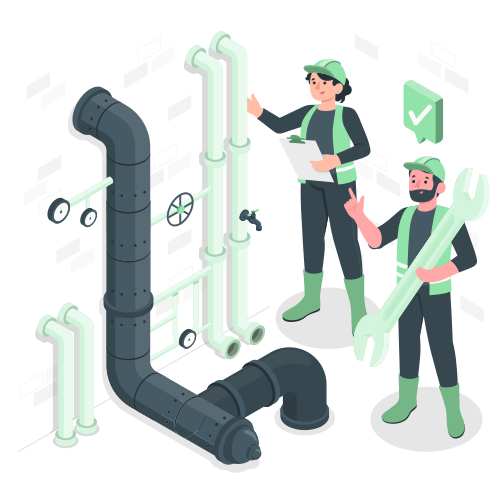
🔧 Solar Water Heater Pressure Relief Valves: Functions, Sizing & Placement
What Temperature and Pressure Relief Valves Do
Every storage tank—solar or conventional—must have a temperature and pressure (T&P) relief valve rated to open before the tank reaches unsafe conditions. According to the 2024 ICC IPC and AS/NZS 3500 standards:
- Pressure rating: Valves must handle the system’s design pressure, typically up to 150 psi (10.3 bar).
- Temperature rating: Valves are set to release at approximately 210°F (99°C), protecting the tank from boiling and rupture.
- Discharge pipe rules: The discharge line must be the same diameter as the valve outlet (usually ¾"), slope downward without restrictions, and terminate within 6 inches of the floor or into a safe visible drain. No shutoff valves or kinks are allowed.
Sizing and Placement
Install the T&P valve:
- At the top of the storage tank where the hottest water collects.
- With the temperature sensor probe inserted into the tank.
- Connected to a code-compliant discharge pipe that routes safely outdoors or to a floor drain.
For indirect solar hot water heat exchanger systems, you’ll also need an expansion tank on the closed glycol loop to absorb thermal expansion. Neglecting this component was flagged in California’s 2022–2023 field inspections as a top installation error leading to burst pipes and system failures.
Common Mistakes to Avoid
SRCC audits (2021–2023) found:
- Missing relief valves entirely.
- Undersized discharge pipes creating dangerous back-pressure.
- Upward-sloped discharge lines that trap condensate and prevent proper venting.
- Capped or plugged valves installed for cosmetic reasons but rendering safety devices useless.
💡 Personal Tip: Test your T&P valve annually by lifting the lever briefly to flush sediment. If water doesn’t discharge freely or the valve leaks afterward, replace it immediately—these devices are inexpensive but critical.
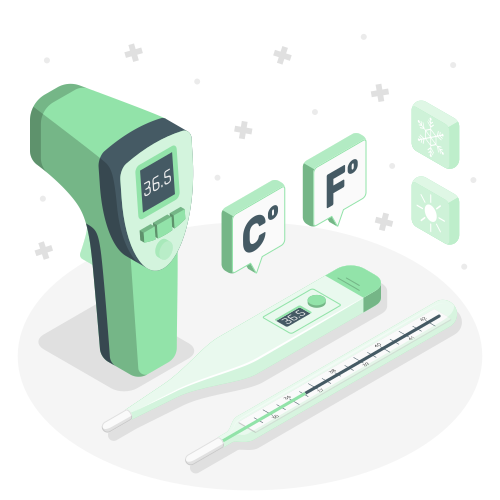
🌡️ Mixing Valves & Scald Protection: Delivering Water at Safe Temperatures
The Scald Risk: Why You Need a Mixing Valve
Water at 140°F (60°C) causes third-degree burns in under 5 seconds for adults and faster for children. Solar systems can push storage temperatures to 160°F (71°C) or higher on clear summer days. A thermostatic mixing valve (TMV) blends hot solar water with cold supply water to deliver a safe 120–125°F (49–52°C) at fixtures, as required by ASSE 1017 standards.
Scald timeline reference:
| Water Temperature | Time to Third-Degree Burn |
|---|---|
| 160°F (71°C) | <1 second |
| 150°F (66°C) | ~2 seconds |
| 140°F (60°C) | ~5 seconds |
| 130°F (54°C) | ~30 seconds |
| 120°F (49°C) | ~5 minutes (safe zone) |
Thermostatic vs Electronic Mixing Controls
Thermostatic mixing valves (TMVs):
- Cost: $50–$200 installed.
- Accuracy: Maintain outlet temperature within ±5°F using mechanical thermostatic elements.
- Maintenance: Simple; clean and inspect annually; replace mechanical parts every 5–10 years, especially in hard-water areas.
- Best for: Budget-conscious installations and simpler solar domestic water heater setups.
Electronic mixing controls:
- Cost: Several hundred dollars plus wiring and sensors.
- Accuracy: Precision control within ±1°F using digital sensors and microprocessors.
- Maintenance: Requires sensor calibration and firmware updates; provides diagnostic alerts for early fault detection.
- Best for: Advanced systems with integrated smart home controls and where maximum precision is desired.
For most residential solar water heating design scenarios, a quality TMV offers excellent protection at lower cost and complexity. Electronic controls shine in larger or multi-zone applications where tight temperature regulation and remote monitoring add value.
Placement Best Practices
DOE field assessments (2020–2022) documented scald incidents where mixing valves were installed downstream of the solar storage tank instead of at the point of use or whole-house distribution. Correct placement:
- Whole-house approach: Install the TMV immediately after the solar storage tank outlet, blending solar-heated water with cold supply before distribution.
- Point-of-use approach: Install individual TMVs at high-risk fixtures (showers, bathtubs) for localized scald protection.
- Never bypass: Ensure all hot-water outlets receive tempered water; direct connections from the solar tank to fixtures violate code and create liability.
🚨 Important Note: One documented DOE case study found a homeowner fined after a mixing valve was installed incorrectly, resulting in dangerously high outlet temperatures and an ASSE 1017 violation. The system required costly retrofitting and recertification.

⚙️ Temperature Monitoring & Control: Sensors, Controllers and High-Limit Shutoffs
How Controllers Protect Your System
Active solar water heating systems use differential temperature controllers that compare collector and tank temperatures. When the collector is warmer by a set threshold (typically 5–10°C), the controller activates the pump to circulate fluid. But controllers also provide critical safety functions:
- High-limit shutoff: If the tank reaches a dangerous temperature (often set around 170–180°F / 77–82°C), the controller stops the pump to prevent boiling and over-pressure.
- Freeze protection: In cold climates, controllers can trigger brief recirculation of warm tank water through collectors or activate backup heat tape to prevent freeze damage.
- Stagnation management: On hot, low-demand days, the controller can shut down circulation to avoid excessive tank temperatures and fluid degradation in closed-loop systems.
Sensor Placement and Calibration
Temperature sensors are the eyes of your controller. California Title 24 and SRCC OG-300 standards require:
- Collector sensor: Mounted directly on the absorber plate or in the manifold to measure actual solar gain.
- Tank sensor: Inserted into a thermowell near the bottom of the solar storage tank for accurate stratification monitoring.
- Annual calibration: Manufacturers and DOE recommend testing sensor accuracy annually. Drift of just a few degrees can prevent proper pump activation or allow dangerous over-temperature conditions.
According to DOE regulations and leading manufacturers, sensors and electronic components typically last 10–15 years. Plan for replacement as part of long-term maintenance to keep your energy efficient water heater running optimally.
Required Temperature-Indicating Devices
ICC incident reports (2019–2024) cite lack of required temperature-indicating devices as a frequent code violation. Many jurisdictions mandate visible temperature gauges on:
- The solar storage tank.
- The collector loop (for indirect systems).
- The outlet side of mixing valves.
These gauges provide at-a-glance confirmation that the system is operating within safe parameters and simplify troubleshooting.
💬 Expert Advice: SRCC-certified systems integrate safety sensors and controls as part of the OG-300 configuration, reducing the risk of oversights. When choosing components, verify that controllers include high-limit shutoffs and that sensors meet manufacturer specifications for accuracy and durability. – SRCC Certification Program

📜 Codes & Standards You Must Know: IPC, SRCC, AS/NZS and Local Amendments
2024 ICC International Plumbing Code (IPC)
The IPC governs plumbing installations in the United States and sets baseline requirements for water heaters, including solar systems. Key provisions:
- Chapter 5 Water Heaters: Mandates T&P relief valves rated for the tank’s working pressure and temperature, with compliant discharge piping.
- Backflow prevention: Requires check valves and other devices to prevent cross-contamination between the solar loop and potable water supply in indirect systems.
- Insulation: All hot-water piping must be insulated to reduce heat loss and improve efficiency.
- Expansion control: Closed systems must include expansion tanks or other means to absorb thermal expansion safely.
Local jurisdictions often amend the IPC, so always verify your municipality’s adopted code version and amendments before beginning your solar water heating installation. For detailed code guidance, refer to the 2024 IPC Chapter 5 Water Heaters.
SRCC OG-300 Certification
The Solar Rating & Certification Corporation (SRCC) certifies complete solar water heating systems under the OG-300 standard. To earn certification, a system must:
- Include all necessary components: collectors, storage tank, heat exchanger (if indirect), controllers, pumps, valves, and safety devices.
- Meet performance benchmarks verified through laboratory testing and field validation.
- Comply with safety standards, including proper T&P relief valve sizing, mixing valve integration, and expansion management.
SRCC OG-300 certification is required to qualify for the 30% U.S. federal Residential Clean Energy Credit and many state/utility rebates. It also provides assurance that the system design has been vetted for safety and efficiency. Learn more about rebates and credits and how OG-300 certification unlocks incentives.
AS/NZS 3500 (Australia/New Zealand)
In Australia and New Zealand, the AS/NZS 3500 Plumbing and Drainage Standard governs solar water heater installations. Key parallels and differences from U.S. codes:
- T&P relief valves: Must open at temperatures around 99°C (210°F) and discharge safely, similar to IPC requirements.
- Mixing valves: Domestic hot-water supply is typically limited to 60°C (140°F) at fixtures to prevent scalding, requiring thermostatic tempering valves.
- Storage and pressure ratings: Tanks and valves must be rated for the system’s design pressure, with clear labeling and compliance documentation.
- Certification: Systems often require compliance with Solar Keymark or equivalent standards for performance validation.
Local Amendments and Permit Requirements
Even with national codes, local building departments impose additional requirements:
- California Title 24: Requires SRCC certification, isolation valves on cold supply and hot water lines, and detailed compliance documentation for multifamily buildings. California Title 24 Multifamily Compliance Manual.
- New York State Plumbing Code: Adopts IPC with amendments; verify backflow preventer specifications and permit timelines.
- Florida and Arizona: Utility rebate programs often mandate post-installation audits verifying compliant relief valves, expansion tanks, and mixing valves before disbursing incentives.
Before you start, contact your local building department to confirm:
- Adopted code version (IPC, UPC, or local code).
- Permit requirements and inspection schedules.
- Specific amendments affecting valve sizing, discharge routing, or sensor placement.
🚨 Important Note: Failing to obtain permits or pass inspections can void warranties, disqualify you from rebates, and create liability if injuries or property damage occur. Always work with licensed contractors familiar with local solar water heating codes.

✅ Installation & Maintenance Checklist for Continuous Compliance
Installation Checklist
Use this checklist during your solar water heating installation to ensure all safety and code requirements are met:
Pressure relief and expansion:
- ✅ T&P relief valve installed at the top of the storage tank, rated for 150 psi and 210°F (or per system design).
- ✅ Discharge pipe sized to valve outlet, sloped downward, terminating within 6 inches of floor or safe drain.
- ✅ Expansion tank (for indirect systems) properly sized and pressurized (typically 20–30 psi).
- ✅ No shutoff valves, kinks, or restrictions in relief valve discharge line.
Mixing valves and scald protection:
- ✅ Thermostatic mixing valve installed at the solar tank outlet or at critical fixtures.
- ✅ Mixing valve set to deliver water at 120–125°F (49–52°C) at taps.
- ✅ Valve complies with ASSE 1017 or equivalent standard.
- ✅ All hot-water outlets receive tempered water; no direct connections from solar tank to fixtures.
Temperature monitoring and controls:
- ✅ Collector and tank sensors installed per manufacturer specifications.
- ✅ Controller programmed with correct differential setpoints (typically 5–10°C on) and high-limit shutoff (170–180°F).
- ✅ Temperature gauges visible on tank, collector loop, and mixing valve outlet.
- ✅ Sensors tested for accuracy; documentation of calibration kept on file.
Code compliance:
- ✅ System design matches SRCC OG-300 certified configuration (if claiming federal tax credit or rebates).
- ✅ Backflow preventers and check valves installed per IPC or AS/NZS 3500.
- ✅ All hot-water piping insulated with UV-rated, weatherproof insulation.
- ✅ Isolation valves installed on cold supply and hot water lines for maintenance access (required by California Title 24).
- ✅ Building permit obtained; inspections scheduled and passed.
Glycol loop (for indirect systems):
- ✅ Propylene glycol mixed to correct freeze-point concentration (verify pH and freeze point).
- ✅ Loop filled, pressurized, and air purged.
- ✅ Pressure gauge confirms stable loop pressure (typically 20–30 psi).
- ✅ System labeled with glycol type, concentration, and fill date.
Ongoing Maintenance Schedule
DOE, SRCC, and leading manufacturers recommend the following maintenance timeline to maintain compliance and safety over 10+ years:
Monthly:
- 🔍 Visual inspection for leaks, corrosion, or visible damage to collectors, piping, and tanks.
Annually:
- 🔧 Test T&P relief valve: Lift lever to flush sediment and verify free discharge. Replace if leaking or non-functional.
- 🔧 Test mixing valve: Measure outlet temperature with thermometer; adjust or replace if out of range.
- 🔧 Check sensors: Verify controller displays match actual tank/collector temperatures; recalibrate if drift detected.
- 🔧 Inspect insulation: Repair UV-damaged or missing insulation on outdoor piping.
- 🔧 Test pump operation (active systems): Confirm pump activates on sunny days when differential threshold is met.
- 🔧 Check loop pressure (indirect systems): Top up glycol if pressure has dropped; investigate leaks.
Every 3–5 years:
- 🔧 Replace glycol (indirect systems): Test pH and freeze point; flush and refill if degraded.
- 🔧 Inspect expansion tank: Verify precharge pressure and bladder integrity.
- 🔧 Service mixing valve: Disassemble, clean, and replace internal components if needed (especially in hard-water areas).
Every 10–15 years:
- 🔧 Replace sensors and controllers: Electronics age; upgrade to maintain accuracy and reliability.
- 🔧 Inspect pumps: Rebuild or replace pumps showing wear or declining performance.
- 🔧 Tank anode rods: Inspect and replace anode rods to extend tank life (for conventional backup tanks or solar tanks with sacrificial anodes).
💡 Personal Tip: I keep a logbook in my utility room documenting each annual valve test, sensor calibration, and glycol change. When the building inspector returned for a routine check, having that history on hand demonstrated ongoing compliance and saved me from a re-inspection fee.

❓ FAQ: Common Safety Mistakes and How to Avoid Them
What happens if I skip the T&P relief valve?
Operating without a T&P valve is illegal under IPC and AS/NZS codes and creates catastrophic risk of tank rupture or explosion. Always install a properly rated valve and compliant discharge line. Never cap or plug the valve—doing so voids warranties and creates liability.
Can I use a standard water heater mixing valve for solar systems?
Standard mixing valves work if they meet ASSE 1017 certification and are rated for the higher temperatures solar systems produce. Verify the valve is designed for 140–160°F inlet temperatures and install it according to manufacturer instructions to ensure scald protection.
How often should I test my mixing valve?
Test annually by measuring outlet temperature with a thermometer. If the water is hotter than 125°F, adjust the valve or replace it. In hard-water areas, more frequent inspection (every 6 months) helps catch mineral buildup early.
What are the most common installation errors that cause code violations?
Based on California Energy Commission and SRCC audits (2021–2023), the top errors are:
- Missing or undersized expansion tanks (closed-loop systems).
- Improper discharge piping on T&P relief valves (undersized, upward slope, or restricted).
- Incorrect mixing valve placement (downstream instead of at the tank outlet or fixture).
- Lack of freeze protection in cold climates (no glycol or drainback mechanism).
- Missing temperature gauges required by local codes.
Do I need a licensed plumber to install safety valves?
Most jurisdictions require licensed plumbers or contractors for solar water heating installations. Attempting DIY work on critical safety components can void permits, warranties, and insurance coverage. Hire a qualified professional familiar with solar water heating design and local codes.
How do I know if my system is SRCC OG-300 certified?
Check the system nameplate or documentation for an SRCC OG-300 certification number. You can verify the certification on the SRCC website. Only OG-300 certified systems qualify for the 30% federal tax credit and most state/utility rebates.
What should I do if my relief valve starts dripping?
A small amount of discharge during heating is normal for expansion relief. Persistent dripping indicates the valve may be stuck open, the expansion tank is undersized, or system pressure is too high. Shut off the system, check the expansion tank precharge, and replace the relief valve if it continues to leak.
Can I adjust the high-limit shutoff temperature on my controller?
Most controllers allow adjustment, but never set the high-limit above 180°F (82°C) unless the tank and system are specifically rated for higher temperatures. Excessive high-limit settings increase scald risk and can degrade glycol or damage tank linings.
What’s the penalty for non-compliant installations?
Consequences include:
- Building department stop-work orders and fines.
- Denial of solar water heating system cost rebates and tax credits.
- Voided equipment warranties.
- Liability for injuries or property damage.
- Difficulty selling your home if the installation doesn’t pass inspection.
How can I find a qualified installer?
Look for contractors with:
- NABCEP certification or equivalent solar thermal training.
- State plumbing/mechanical licenses.
- Experience with SRCC OG-300 systems and local code compliance.
- References and verifiable past installations.
Check our installer’s corner for tips on vetting contractors and ensuring quality work.
💬 Expert Advice: One homeowner shared that their mixing valve was installed incorrectly during a DIY retrofit, resulting in a near-scald incident when their toddler turned on the bathtub tap. After consulting a licensed contractor, they relocated the valve to the correct position and added point-of-use protection at high-risk fixtures. The lesson: even experienced DIYers should consult code and hire pros for critical safety components. – DOE Building America Field Assessment, 2020–2022
Related Articles
- Step-by-Step: Installing a Residential Solar Water Heating System
- All the Parts You Need: Pumps, Controllers, Valves, Heat Exchangers
- Rebates & Credits: How to Qualify for Solar Hot Water Incentives
- Maintenance & Winterization: Keep Your Solar Hot Water Running
- Troubleshooting Guide: Not Hot Enough, Pump Stuck, Freeze Damage